At Skidmore, our faculty are open to different schools of thought in economics and bring diverse skill sets, areas of expertise, and backgrounds to their teaching. That variety creates opportunities for our students to explore many specialties within economics through electives, independent research, and a capstone designed around your interests. 

What will you learn?

Economics majors typically begin with introductory courses in microeconomics and macroeconomics, followed by intermediate microeconomics and macroeconomics, statistical methods, and applied econometrics. Students also complete a senior seminar, where they apply their economic knowledge and research skills to an independent research project. In addition, majors take at least three economics electives, at least two of which must be at the 300 level. Many students choose to take additional electives to explore their interests in greater depth. 

Double majors

Economics pairs naturally with a wide range of fields, and many of our students choose to pursue a double major. Popular combinations include economics with management and business, mathematics and statistics, environmental studies and sciences, political science, history, and philosophy. These combinations allow students to connect economic analysis with complementary perspectives and skills while tailoring their studies to their individual interests and future goals.

Where will you go?

Alumni apply what they’ve learned in careers that value both critical thinking and data literacy. From research to entrepreneurial endeavors, they are using the skills they developed here to make a difference in communities all over the world. 

Career paths Employers Graduate schools
  • Business intelligence analyst
  • Entrepreneur
  • Financial analyst
  • Government and public policy analyst
  • Investment banker
  • Management consultant 
  • Market research analyst
  • Portfolio manager
  • Resource planner
  • Sales strategist
  • AllianceBernstein
  • Berkeley Research Group LLC
  • Deloitte
  • EY
  • Goldfinch Financial
  • Independence Blue Cross
  • International Monetary Fund
  • Prudential
  • Vineyard Vines
  • Wells Fargo 
  • Boston University
  • Brown University
  • Columbia University
  • Johns Hopkins University
  • National University of Singapore
  • Northeastern University
  • London School of Economics
  • University of California Irvine
  • University of Chicago
  • University of Pennsylvania

Wise investments

Collaborative research, independent studies, and credit-bearing internships are highly impactful opportunities for preparing for life after college. Our students have interned with institutions ranging from the federal reserve banks of Dallas and Boston to JP Morgan, HSBC, and the Institute of International Finance. 
Learn more

Christina Ryba

From an actor to an advocate

Hon. Christina L. Ryba ’98, a trailblazer in New York’s legal landscape, is deeply committed to fostering equity in the courtroom, particularly for low-income New Yorkers. After initially wanting to pursue a career in acting, she switched to economics while at Skidmore.
Read Christina's story
Trey Borque in baseball catcher gear stands on a field.

Lessons in leadership

Trey Bourque ’25, a standout double major in economics and management and business, also made his mark at Skidmore as captain of the baseball team and co-president of the Student-Athlete Advisory Committee (SAAC). 
Read Trey's story
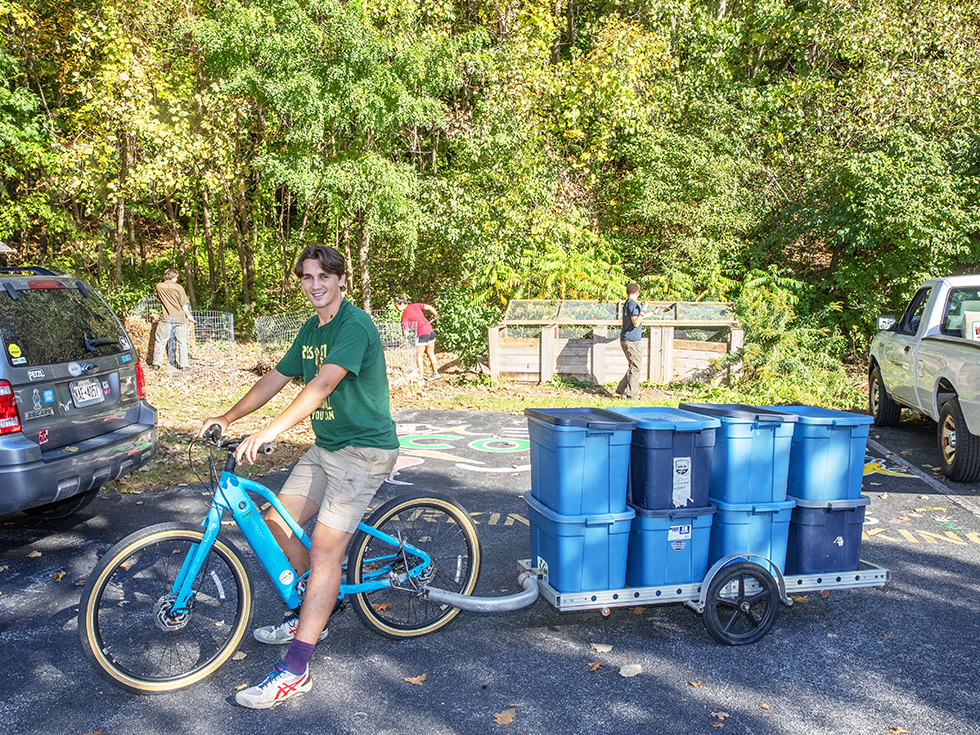
Zak Maxey rides a bike with a cart behind hauling recycling boxes.

Turning over new leaves

Zak Maxey ’27, a philosophy and economics double major, became hooked on Skidmore’s compost program as a way to give back to the environment. He hopes to pursue a career as an environmental lawyer who helps shape policies. 
Read Zak's story
A tree stands tall on a grassy hill in Switzerland with a bright blue sky and a few white clouds in the background.

Get a global perspective

Many economics majors choose to study abroad, combining their academic interests with immersive experiences around the world. These programs help students broaden their perspectives, strengthen cross-cultural skills, and see economics through a new lens. 
Learn more

Frequently asked questions

Find quick answers to common questions about studying economics at Skidmore, from courses and research to study abroad and career paths.

Economics majors build a foundation in microeconomics, macroeconomics, calculus, and statistical methods before moving into intermediate and advanced courses. Students also choose economics electives based on their interests and complete the major with a senior seminar during their final year. The economics major at Skidmore is classified as STEM.

Explore the economics major

Yes. Economics can complement many other areas of study. Students often pair the economics minor with mathematics and statistics, computer science, psychology, or management and business.

Explore the economics minor

Economics students can extend their learning beyond regular courses through collaborative research with faculty, independent studies, and credit-bearing internships. These experiences give students additional ways to investigate economic questions and apply what they’re learning.

Students can explore topics ranging from behavioral economics, healthcare, and environmental economics to international trade, public finance, labor economics, sports, and economic inequality. Special topics courses give faculty opportunities to offer courses on timely economic questions.

Economics graduates pursue a range of paths, including graduate study and careers in private industry, consulting, government, and nongovernmental organizations.

Faculty

Creative. Thoughtful. In your corner.
Meet your professors

Contact Economics

Office

Filene, 2nd Floor
Phone: 518-580-5090
Fax: 518-580-8067

Chair

Monica Das
Professor
mdas@skidmore.edu

Administrative Assistant

Amelia Clark
acclarke@skidmore.edu